

Gmax Testing and Turf Field Safety
The Safety Standards, Testing Protocols, and Maintenance Decisions That Protect Athletes and Institutions
Most athletic directors do not think about field safety until something goes wrong. A player goes down. A coach raises a concern. A parent sends an email. And suddenly everyone is asking a question nobody had a good answer to.
The reality is that synthetic turf fields, like every piece of athletic infrastructure, have a measurable lifespan and testable safety standards. Knowing where your field stands is not complicated. But ignoring it can be costly in ways that go well beyond the price of replacement.
MMTH (pronounced Mammoth) Sports Construction installs, maintains, and evaluates athletic fields across the country using Shaw Sports Turf products, one of the most tested and rigorously validated turf systems in the industry.
What is Gmax testing and why does it matter for athlete safety?
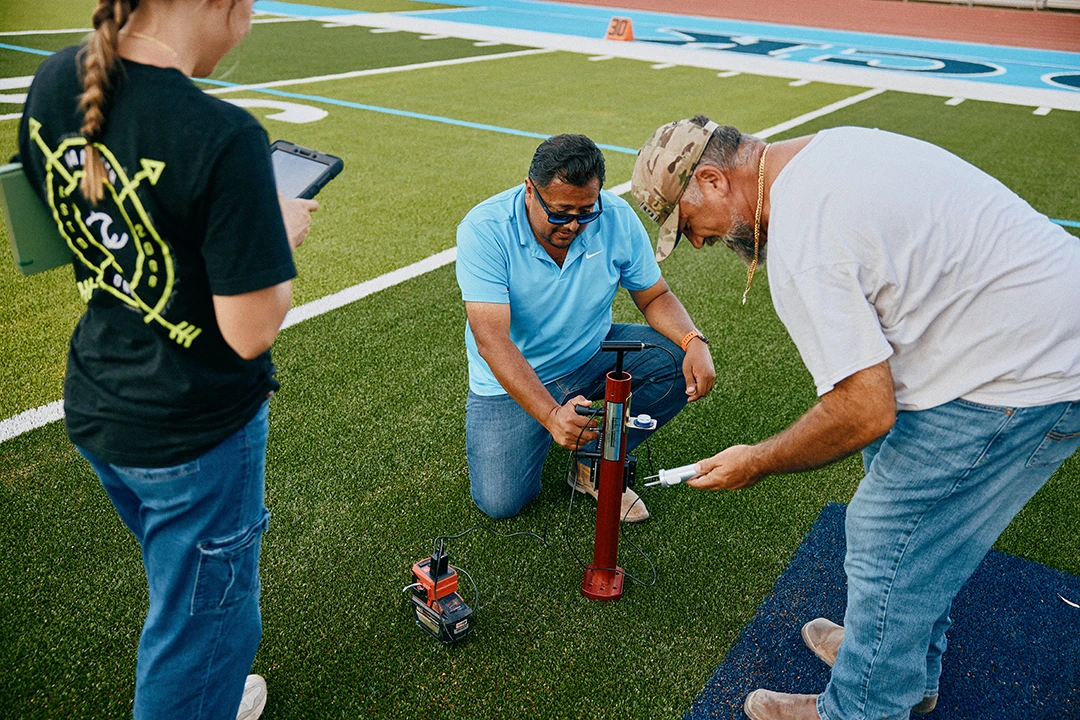
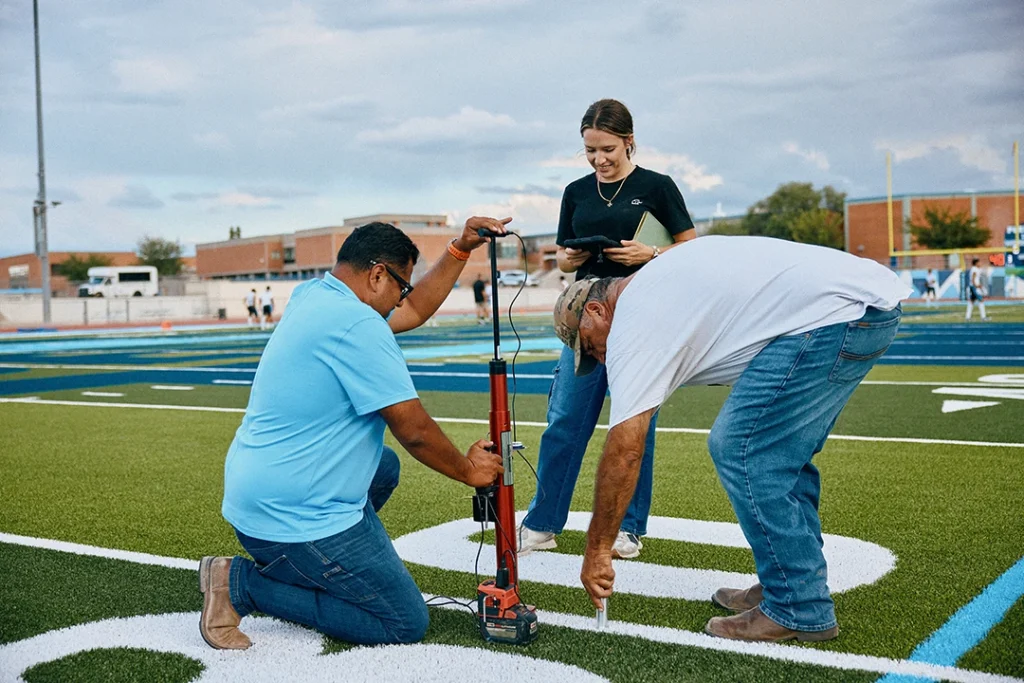
Gmax measures the peak impact force, specifically the G-force, a playing surface transmits back to an athlete’s body on contact. Testing is standardized under ASTM F1936, the American Society for Testing and Materials’ specification for impact attenuation of turf playing systems. The equipment is a specialized drop-weight device: a weighted tube is dropped from a standardized height at multiple spots across the field, and the instrument measures how much force is absorbed by the surface versus transferred back through it to the athlete’s body.
The result tells you how much force the surface absorbed versus how much it returned to the athlete. A higher number means less absorption and a harder, more dangerous surface. As a field ages and its fibers compact and break down, that Gmax number climbs, and so does the injury risk. Higher Gmax values correlate directly with greater risk of concussions and other injuries, which is why ASTM F1936 exists as a mandatory safety specification and not simply a guideline.
It is worth noting that Gmax is one piece of a comprehensive safety picture. Shaw Sports Turf’s PEAK Performance Lab evaluates turf systems across seven distinct playability metrics, including head injury criterion, rotational traction, force reduction, and energy rebound, to assess how a surface performs across the full range of athlete interaction. The fields MMTH installs are built against that same standard from day one.
What is a safe Gmax rating for a turf field?
What is a safe Gmax rating for a turf field?
Two organizations set the standards schools should understand, and their thresholds are different by design.
ASTM International is a globally recognized standards body that publishes the test methods and specifications used across engineering, materials, and safety fields. Under ASTM F1936, Gmax readings shall not exceed 200 at any individual test point. This is the regulatory safety baseline in the United States, grounded in biomechanical research establishing that above 200 G, the risk of life-threatening head injury increases substantially. A field at or above 200 must be taken out of service.
The Synthetic Turf Council (STC) is a nonprofit trade association founded in 2003, dedicated to education, advocacy, and quality standards for the synthetic turf industry. Its membership spans manufacturers, installation contractors, testing laboratories, maintenance providers, and field owners. In its Guidelines for the Performance and Quality of Synthetic Turf Fields (revised September 2024), the STC sets a more protective standard: Gmax should remain below 165 for the entire operational life of the field. This is the industry best practice threshold, not a legal minimum. It reflects where the industry believes fields should perform to genuinely protect athletes, not merely where they must perform to avoid a regulatory failure.
A properly installed, well-maintained field should operate in an ideal range between 90 and 115, which reflects performance comparable to high-quality natural grass. A new field built to quality specifications typically installs in or near this range.
To put the full picture in plain terms:
- 90 to 115: Ideal performance range, comparable to natural grass
- Below 165: STC industry best practice threshold for the life of the field
- 165 to 199: Technically compliant under ASTM but the STC guideline has been exceeded; immediate maintenance, deep grooming, or infill replenishment is needed
- 200 or above: ASTM threshold exceeded; field must be taken out of service
The gap between 165 and 200 matters. A field sitting at 185 is legally within the ASTM limit but has already failed the STC’s industry standard for ongoing athlete protection. Schools relying solely on the 200 number are operating with less margin than the industry recommends.
How often should synthetic turf fields be tested?
For brand new fields, Gmax testing at installation establishes a critical baseline. In the first several years of a field’s life, numbers are generally stable and the surface is performing well.
A practical testing schedule looks like this:
- At installation: Establish your baseline reading
- Years 1 to 5: Test every other year; the field is in its prime and year-to-year changes are typically minimal
- Year 5 and beyond: Annual testing is recommended as fibers begin breaking down from consistent use and UV exposure
Some districts choose to test annually throughout the field’s entire life. That is a reasonable approach, and from a liability standpoint it creates a documented record demonstrating active monitoring of athlete safety, which carries real institutional value if questions ever arise.
What does Gmax Testing cost?
A standalone Gmax test typically runs $1,200 to $1,800. It can also be folded into an annual maintenance contract, which is generally the more cost-effective approach for schools that want regular upkeep and documented safety records in one package.
Given the cost of a field replacement and the cost of a single injury claim, this is one of the most affordable risk management investments available to a school district.
Who performs Gmax testing?
Gmax testing should be performed by qualified professionals with certified equipment. MMTH performs Gmax testing as part of its field maintenance and evaluation services. Not every contractor offering field evaluations has the right equipment or credentialed staff, so it is worth confirming before scheduling.
What are the warning signs that a turf field is becoming unsafe?
Gmax testing gives you the numbers. But there are physical and visual indicators worth watching between formal evaluations:
- Fiber matting: Blades that lie flat instead of standing upright signal significant wear and reduced shock absorption
- Fiber loss: Loose fibers visible on the surface, or fibers that pull out easily, indicate the system is breaking down
- Hardness underfoot: A field that simply feels harder than it used to. Athletes and coaches often notice this before any formal test confirms it
- Uneven infill distribution: If rubber infill has migrated away from high-traffic areas, those spots will test higher and perform inconsistently
- Visible surface irregularities: Low spots or soft spots can indicate base settling beneath the turf, which is a separate and often more serious problem than surface wear alone
One warning sign schools commonly miss is a change in injury patterns. When lower extremity injuries such as ankle rolls, shin splints, and stress fractures start increasing across a team or season, the field surface should be evaluated. As Shaw Sports Turf’s PEAK Lab research demonstrates, fiber degradation affects the entire system. As fibers compact down or fall off, the surface loses its ability to perform effectively across all seven athlete safety metrics, not just impact absorption. Harder surfaces take a cumulative physical toll on athletes that shows up in injury rates before it is obvious to the eye.
How long does a synthetic turf field last?
Turf manufacturers warrant their products for eight years. That is the industry baseline, the floor, not the ceiling.
The actual lifespan of a field depends heavily on how well it is maintained. MMTH has worked with fields that reached 17 years of safe, serviceable use because of consistent annual care. On the other end, fields as young as four years have deteriorated to unacceptable safety conditions because maintenance was deferred or skipped.
Shaw Sports Turf backs its GAME ON product line with a Limited Lifetime Warranty, the first of its kind in the turf industry, covering football, soccer, lacrosse, baseball, and softball fields using GAME ON Legion, PowerBlade, and Momentum systems. That warranty reflects the confidence that comes from manufacturing quality and a real-world performance track record. But even the best turf system requires proper maintenance to reach its potential lifespan.
For a deeper look at what drives replacement timing beyond age and test results, see the MMTH guide: When It’s Time to Replace a Synthetic Turf Field.
How does field usage intensity affect safety and lifespan?
A field hosting forty events per year ages differently than one hosting ten. More use means faster fiber breakdown, more infill displacement, and higher cumulative compaction, all of which drive the Gmax number up more quickly.
For high-use and multi-sport fields, maintenance frequency needs to reflect that reality. That said, running professional grooming equipment too frequently can actually accelerate fiber degradation. Turf fibers are polyethylene and polypropylene, and excessive mechanical passes eventually do more harm than good. A qualified maintenance partner can help calibrate the right schedule for your field’s specific use pattern.
What happens when a field fails a Gmax test?
A reading at or above 200 means the field should be taken out of service until it is remediated or replaced. Adding rubber infill can marginally lower readings in the short term, but this does not address underlying fiber breakdown or base condition. It buys limited time and is not a solution.
When MMTH evaluates a field in this condition, the honest guidance is replacement planning, not patchwork.
The better scenario, and the one regular testing makes possible, is identifying a field trending toward 165-180 with several years of warning. That creates time to plan funding, schedule construction around athletic seasons, and approach the project as a managed capital investment rather than an emergency.
Can a field become unsafe because of what is underneath the turf, not the surface iteself?
Yes, and this is one of the most important and least discussed dimensions of field safety.
The base layer does the foundational work of the entire system. Poor base construction, including inadequate compaction, improper drainage design, or substandard aggregate, leads to settling over time. That creates uneven areas on the playing surface that increase ankle injury risk and accelerates deterioration of the turf above it.
When MMTH does a field evaluation, part of the assessment looks specifically at whether surface problems are actually base problems in disguise. A Gmax reading might come back within an acceptable range while base irregularities visible in the surface profile tell a different story. In those cases, replacing the turf without addressing the base means the same problems return within a few years.
The base is the most important part of the system. It is also where shortcuts taken during original construction are most likely to surface as expensive problems later. For a complete breakdown of what proper athletic field base construction looks like, layer by layer, see: What’s Under a Turf Field and Why It Matters.
Is the rubber infill in synthetic turf fields safe for athletes?
This question comes up regularly and deserves a direct answer. Certified crumb rubber infill is tested before it leaves the manufacturing plant, including testing for PFAS (per- and polyfluoroalkyl substances) and heavy metals. Product that passes this testing is classified and sold as certified crumb rubber.
MMTH offers a range of infill options beyond traditional rubber, sourced through our Shaw Sports Turf manufacturing partnership, including organic alternatives designed for specific performance and safety profiles. GeoFill, a coconut fiber-based infill manufactured by Shaw, is Cradle to Cradle Certified and provides natural cooling properties alongside strong field performance. FLXZONE, also manufactured by Shaw and made from natural cork, absorbs impact, resists moisture, and is well suited for high-contact sports. Both are options MMTH can specify for schools that want to reduce reliance on rubber infill.
Regulatory standards vary by state. California maintains ongoing review processes that differ from most other states. Schools should ask their contractor specifically which infill is being used and confirm it is certified. MMTH provides full documentation on infill materials for every installation we complete.
Are synthetic turf fields hotter than natural grass, and what can be done about it?
Yes. Synthetic turf fields get hotter than natural grass in direct sun, and this is a real athlete safety consideration for summer practices, preseason camps, and schools in warmer climates.
Watering the field is a common response but it is counterproductive. It raises surface humidity without meaningfully reducing temperature, and the effect disappears quickly.
The more effective solution is organic infill. Shaw’s GeoFill is specifically engineered to cool the field fast and hold up through heat, rain, and heavy play, keeping athletes cooler longer with less water and less maintenance required. For schools in hot climates or with heavy summer scheduling, GeoFill is worth serious consideration as part of the original field specification. It is an added investment upfront, but it addresses a real safety concern that standard rubber infill does not.
What does GAME ON technology mean for athlete safety?
MMTH installs GAME ON turf as part of our Shaw Sports Turf partnership, and it is worth understanding what that means from a safety standpoint, not just an aesthetics one.
Traditional field installations involve cutting and inlaying separate pieces of turf for logos, hash marks, numbers, and field markings. Each cut creates a seam, and seams are potential failure points where edges can lift, separate, or catch a cleat. GAME ON technology tufts all graphics and field markings together in a single manufacturing run, reducing inlaid turf by up to 82 percent and seam tape by up to 50 percent compared to conventional fields.
Fewer seams means less maintenance risk over time and an increased element of safety for athletes on the field. Select GAME ON products have also passed the new NFL surface testing requirements, a validation standard that goes well beyond what most high school and collegiate fields are ever measured against.
Do natural grass fields have the same safety standards?
Yes. Gmax testing applies to natural grass fields, and the same safety thresholds matter. A compacted, drought-stressed, or poorly maintained grass field can test just as dangerously high as an aging synthetic field.
The difference is in remediation. When a natural grass field tests too high, the options are aggressive aeration, sand infill, and resodding, processes that take the field out of service for weeks and require precise seasonal timing to re-establish before the next sports season. It is resource-intensive and difficult to execute well without dedicated grounds staff.
Most high school programs do not have the staffing or budget to maintain natural grass at the standard required to keep Gmax numbers consistently in a safe range. That gap between what proper maintenance requires and what most schools can realistically provide is one of the practical arguments for synthetic turf, not just the all-weather usability, but the predictability of the safety profile over time.
Are schools liable if an athlete is injured on and unsafe field?
Liability questions belong to legal counsel. What MMTH can speak to from years of field work is this: documentation is everything.
Schools with a documented testing history, including Gmax records, maintenance logs, and written field evaluation reports, are in a fundamentally different position if an injury ever occurs. Documentation demonstrates active, reasonable oversight. The absence of any records creates a much harder conversation.
This is one of the core reasons MMTH structures its maintenance program around written reporting. After every service visit, schools receive a documented assessment covering current field conditions, areas of concern, maintenance performed, and recommended timelines. This gives athletic directors something concrete to bring to administrators and school boards when making the case for capital investment.
If a school suspects a safety problem, what should they do first?
Call MMTH for a free field evaluation before spending any money or committing to a decision.
MMTH offers free field evaluations for any school or district, regardless of who installed the original field. Here is what that process looks like:
- A MMTH team member visits the site and performs a visual inspection covering surface condition, fiber integrity, and visible base irregularities
- Infill depths are measured across the field to identify distribution issues
- If the visual inspection warrants it, Gmax testing is performed on-site
- A written report is provided documenting current conditions, photographic evidence of problem areas, test results, and specific recommendations
That report gives the school something real to act on. It gives administrators and board members the documented evidence they need to understand the issue and support a path forward, whether that is a maintenance program, a planned replacement, or simply confirmation that the field is in good shape.
What does deferred maintenance actually cost?
More than anyone wants to calculate.
One situation MMTH has observed firsthand: a school deferred turf replacement for nine years past when it should have been addressed. The field was eventually shut down and taken out of use entirely. In that window, the school has been renting practice and game facilities at ongoing expense. When replacement finally moves forward, material costs have roughly doubled due to inflation and labor costs have followed. The total financial impact, rental fees plus inflated construction cost, is many times what proactive replacement would have run.
We’ve witnessed this pattern repeat across school districts. Deferred maintenance feels like budget management in the short term, however, over a five to ten year horizon, it almost always costs significantly more in dollars, in disruption, and sometimes in the outcomes that drive both.
How should schools budget for turf field replacement?
The smartest approach is to treat a synthetic turf field as a depreciating capital asset with a known replacement cycle and plan for it from the day the field goes in.
One model worth considering: set aside a fixed annual amount, into a dedicated capital replacement fund for each field. Over eight to ten years, that accumulation can cover a meaningful portion of the replacement cost. It will not close the entire gap, but it changes the conversation from an emergency budget request to a planned capital expenditure with partial funding already in place.
Phased investment is another practical path for schools managing multiple facility needs simultaneously. Identifying the highest-risk assets first, the oldest surfaces with the highest Gmax readings and heaviest use schedules, and sequencing replacements over several budget cycles makes the total investment manageable without indefinitely deferring safety.
For schools thinking about this in the context of a broader facility strategy, the MMTH article on What Is an Athletic Facility Master Plan walks through how organized, long-range planning prevents the kind of reactive spending that consistently costs districts the most.
Is there anything about field safety most schools do not fully understand?
Maintenance is what keeps athletes safe, not just the surface they play on.
Most people assume that because synthetic turf is artificial, it largely takes care of itself. It does not. Annual professional maintenance, including grooming, infill redistribution, and fiber decompaction, is what separates an eight-year field from a twelve or fifteen-year field. It is also what keeps Gmax numbers in the safe range year after year instead of climbing toward a failed test.
The schools that get the most out of their facility investments, and whose fields are genuinely safe to play on season after season, treat maintenance as a non-negotiable operating cost. With a proper maintenance program in place, MMTH can typically give schools several years of advance notice before a field reaches end of life. That is enough time to plan, budget, and build on your timeline rather than in response to a crisis.
Ready to know where your field stands?
MMTH offers free field evaluations for schools and districts regardless of who installed the original surface. If you have questions about your field’s current condition, its remaining safe lifespan, or what a testing and maintenance program should look like for your facilities, reach out to start the conversation.
MMTH is a vertically integrated athletic construction company serving schools, universities, and municipalities. Our Shaw Sports Turf partnership means the fields we install are backed by some of the most rigorously tested products in the industry. Our field maintenance and evaluation services include Gmax testing, annual grooming, infill management, and full-field assessments.