

One Field, Multiple Sports
One Field, Multiple Sports: How Multi-Sport Athletic Field Design Actually Works
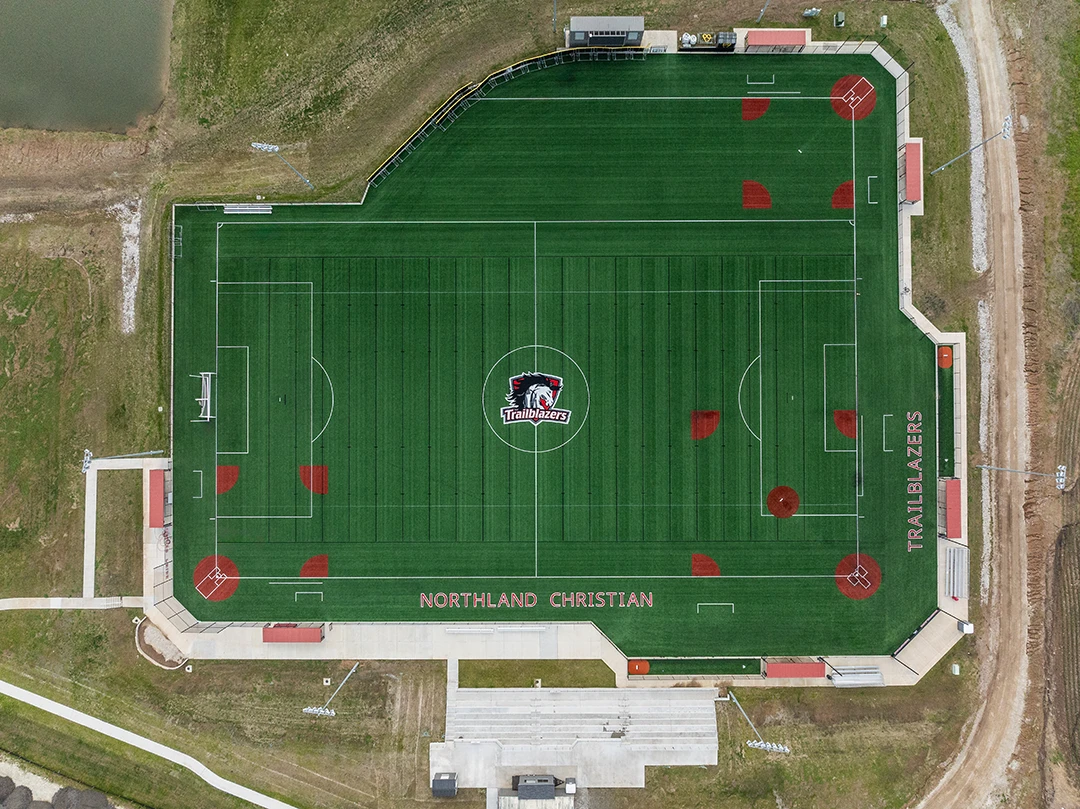
Add a new sports program, and somewhere a facilities planner is staring at a site plan wondering where it’s going to play. Whether it’s a school adding a new sport or a city trying to serve more leagues on the same parcel, offerings are growing faster than land is. More teams are being asked to share fewer acres. One field can genuinely carry two, three, even four sports, but only when it’s designed that way from the start.
What Does It Mean For A Field To Be “Multi-Sport”?
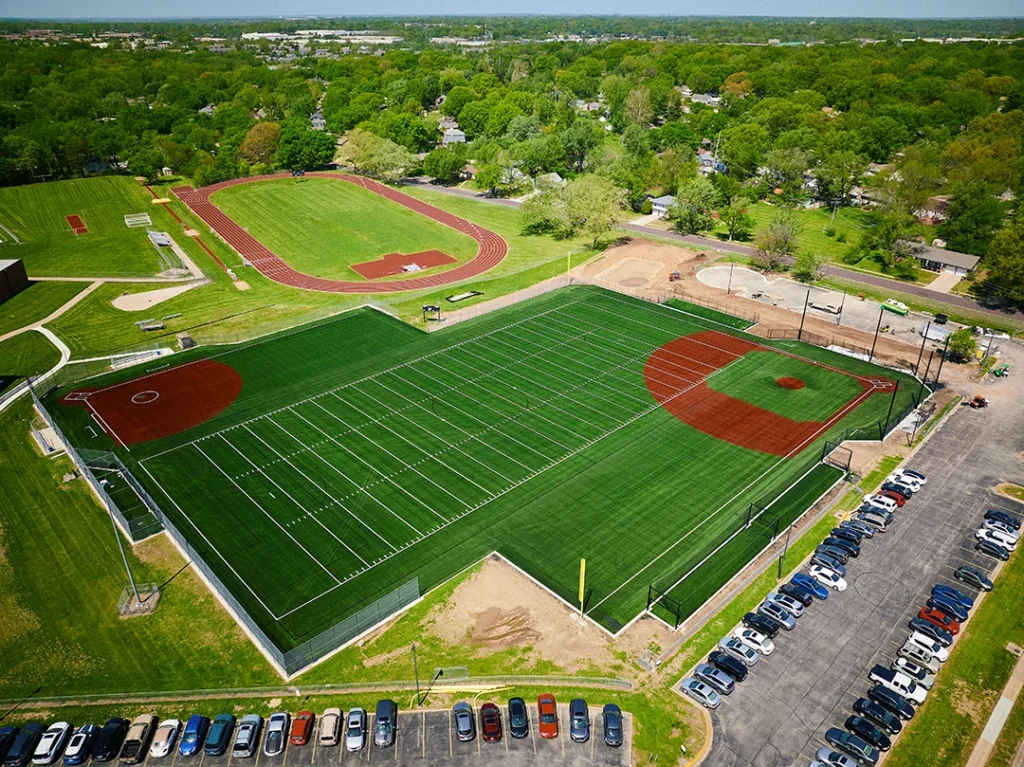
A true multi-sport field is designed from the outset to accommodate more than one sport while meeting the full standards required for each one. Proper dimensions, runoff areas, foul territories, safety zones, and field boundaries are all maintained so that each sport does not take away from the other. That standard, not simply how many sports a field can technically support, is what separates a genuinely multi-sport field from one that has just had a second sport’s lines added to it after the fact.
What Sport Combinations Work Best Together?
Rectangle sports pair naturally with other rectangle sports. Football, soccer, lacrosse, and more recently common flag football, share very similar field geometry and size, which makes combining them relatively straightforward.
What has shifted more recently is the ability to combine diamond sports like baseball and softball with rectangle sports. The most common approach aligns the rectangle field’s boundary along the baseball field’s foul line, effectively using the outfield space to house a soccer or football field. This requires some compromise on the baseball side. A field designed this way may require a longer foul line distance, for example 330 feet instead of a more standard 310 to 315 feet, in order to accommodate a full-size rectangle field within the same footprint.
Fields can technically accommodate markings for as many as four or five different sports, but that is not where MMTH generally recommends landing. Our guidance is to limit permanent, inlaid markings to two or three sports at most. Beyond that, additional sports are better served with painted lines or tick marks, which keeps the field readable for officials, players, coaches, and spectators rather than layering on more permanent lines than the surface can clearly support.
What is the Difference Between A Field Designed For Multiple Sports From The Start Versus One That Had A Second Sport Added Later?
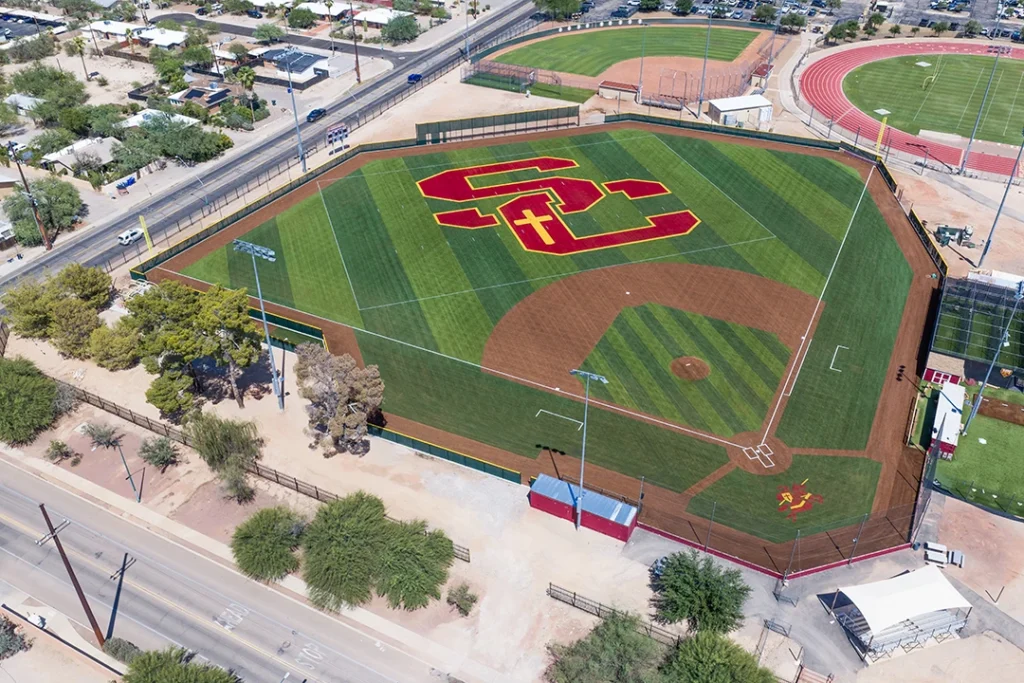
The difference is significant, and it comes down to intentional design versus retrofitting. A field planned for multiple sports from day one accounts for every sport’s specific requirements at the design stage, including foul territory, required runoff space, boundary spacing, and field orientation. That intentional integration, permanent inlaid markings built into the turf system itself, planned drainage and runoff, and orientation decisions made with every sport in mind, helps prevent the kind of conflicts that are common when a second sport gets added to a field after it was already built for one.
Retrofitted fields are working within constraints that were never designed to accommodate the added sport, which is why space, drainage, and boundary conflicts tend to surface. That does not mean painted lines have no place in multi-sport design. Painted markings are still a practical option for a field’s secondary or tertiary sports, or for sports still being evaluated at a site. The distinction that matters most is whether the full field, including every sport it needs to support, was planned as a system from the outset.
Does Field Orientation Change When Designing For Multiple Sports?
Yes, orientation is always a factor. In ideal conditions, rectangle sports are typically oriented north-south, while diamond sports are oriented toward the northeast. When a rectangle field is aligned along a baseball field’s foul line, that configuration tends to work well for both sports without requiring either one to give up its preferred orientation entirely.
In situations involving multiple fields on the same site, such as a four or five field complex, not every field can achieve the ideal orientation for every sport it supports. Part of the design and site planning process involves identifying which sport will take priority on a given field and making the compromises necessary to support secondary sports without significantly undermining the primary one.
Are There Sport Combinations That Don’t Work Well Together?
Not in the way the question implies. Almost any combination of field sports can share a surface, and the bigger variable is not field geometry or whether the sports themselves are compatible. It is turf type.
Different sports do ask different things of the turf. Football benefits from a more rugged, all-purpose system with a longer pile height that stands up to high-contact, high-volume use. Baseball and soccer, particularly in their purest form, perform best on a shorter pile height and often a different infill built for ball roll and ball bounce, and within a single baseball field the ideal pile height is even shorter on the infield than on the outfield. Left unaddressed, those differing preferences are what lead people to assume certain sports simply do not mix.
What has changed is the range of turf systems now available to reconcile them. MMTH manufactures multiple systems built for exactly this decision, from rugged, longer-pile surfaces engineered for football and other high-contact use, to shorter monofilament systems tuned for the ball response that baseball and soccer want. For fields that genuinely have to do it all, a hybrid system blends the characteristics of both, pairing the durability of a high-traffic surface with the true, consistent ball roll and bounce that sports like baseball and soccer rely on. Each system is also offered in multiple performance tiers, so the surface can be matched not only to the mix of sports but to the level of play a program is building for.
The result is that the tradeoff people expect is far smaller than it used to be. Rather than accepting that a shared field cannot perform for any single sport, the real work is matching the right system, and the right tier, to how the field will actually be used. Tell us every sport the field needs to serve and how heavily each one will be played, and that becomes a design decision we solve for, not a compromise you are stuck with.
Do High-Impact and Low-Impact Sports Sharing A Surface Create Uneven Wear Patterns?
Not in the way many people assume. Wear patterns are driven primarily by repetitive use of the same specific location, such as a center fielder’s position, a pitcher’s mound area, or a batter’s box, rather than by whether a sport is high-contact or low-contact.
On a multi-sport field, different activities create wear in different specific spots, such as where blocking drills repeatedly occur versus where seven-on-seven practice tends to concentrate. Being mindful of this and rotating where practices and drills take place across the field helps distribute wear more evenly and extends the usable life of the surface. Consistent maintenance of those specific locations is a critical factor in longevity.
The turf system itself also plays a role. MMTH’s slit-film and interlaced fiber systems are engineered to lock infill in place and reduce the fly-out and migration that heavy, varied use tends to cause. Choosing a system built for infill stability means the surface holds its playing characteristics longer and puts less of the burden on grooming to keep wear in check.
Does Multi-Sport Use Shorten A Field’s Lifespan?
Surprisingly, the difference is minimal. What ages synthetic turf and shortens its usable life is primarily environmental exposure, particularly UV degradation of the turf fibers and infill over time, not the amount of foot traffic or contact the surface receives. A well-maintained field generally lasts 8 to 12 years whether it serves one sport or several.
Multi-sport fields do require more frequent grooming and maintenance, largely due to increased infill migration from more varied use patterns. That translates to more regular upkeep, not necessarily a shorter overall lifespan.
The turf system can narrow even that gap. MMTH’s interlaced slit-film systems are built to hold infill in place and resist the migration that drives much of the added grooming on a multi-sport field, and every system is constructed on a durable backing engineered for long-term integrity under heavy, varied use. A field specified with infill retention and durability in mind behaves more like a single-sport surface in day-to-day maintenance, even while carrying several sports.
For a closer look at what actually wears a field out and how to recognize when one is nearing the end of its life, see our guide on when it’s time to replace a synthetic turf field.
What Turf Options Work Best For Multi-Sport Fields?
MMTH’s turf systems, manufactured by Shaw Sports Turf, one of the most established names in synthetic athletic surfaces, offer three distinct systems, and the right choice depends on the mix of sports a field needs to serve. A slit-film system uses a durable, interlaced fiber that holds infill in place and stands up to the high-contact, high-volume demands of football and other rugged, multi-purpose use. A monofilament system uses fibers built to look and play like natural grass, with the shorter profile and true ball response that baseball and soccer depend on. And for fields supporting a genuine mix of both, a hybrid system blends the two, pairing the durability of a high-traffic surface with the ball roll and playability of a finer, natural-grass-style fiber. Each of these is offered in multiple performance tiers, so the same system can be specified for elite competition or for a high-value everyday program.
Field markings factor into the turf decision as well. Shaw Sports Turf’s GAME ON™ advanced tufting technology allows multiple sets of lines to be built into the turf during manufacturing, rather than cut in separately for each sport after installation. Reducing the number of physical cuts into the turf backing improves both player safety and the field’s long-term durability, which becomes increasingly valuable as more sports share the same surface.
How Do You Apply Multiple Sets if Field Markings Without Confusing Players, Coaches, and Officials?
This is managed through an intentional color hierarchy. The primary sport on a given field is typically marked in white, which is treated as the industry standard for a field’s number one use. Secondary sports are commonly marked in yellow, and further distinctions, such as separating practice use from competition use, may be handled with a lighter gray tone.
For sports that are used less frequently or are still being evaluated for a site, tick marks offer a lighter-weight alternative to full permanent lines. Tick marks are small, minimal reference points that indicate where a boundary, yard line, or other key measurement falls without laying out a full continuous line. Rather than committing the field to another complete marking system, tick marks give grounds crews and officials just enough of a reference to correctly lay out that sport’s boundaries or position equipment when needed.
Some fields are designed with one primary set of full markings and tick marks for every secondary sport, so that only the relevant reference points are visible for whichever sport is using the field at a given time.
Some states have specific mandates around marking colors for interscholastic fields, so verifying local jurisdictional requirements is an early step in any project. School colors also play a role in these decisions. Certain colors, like red, tend to show up clearly against green turf, while darker colors such as navy blue can be more difficult to see and require additional consideration during the marking design process.
Is There A Limit To How Many Sports A Single Field Can Support?
A field can technically accommodate markings for as many as four or five different sports. MMTH’s recommendation is to keep permanent, inlaid markings to two or three sports. Beyond three sets of permanent lines, a field starts to become visually cluttered and difficult for players, coaches, and spectators to read clearly. Additional sports beyond that point are better served through tick marks or painted lines rather than more permanent marking sets, which keeps the field readable without limiting how many sports it can ultimately support.
How Does A Multi-Sport Field Affect The Fan And Spectator Experience?
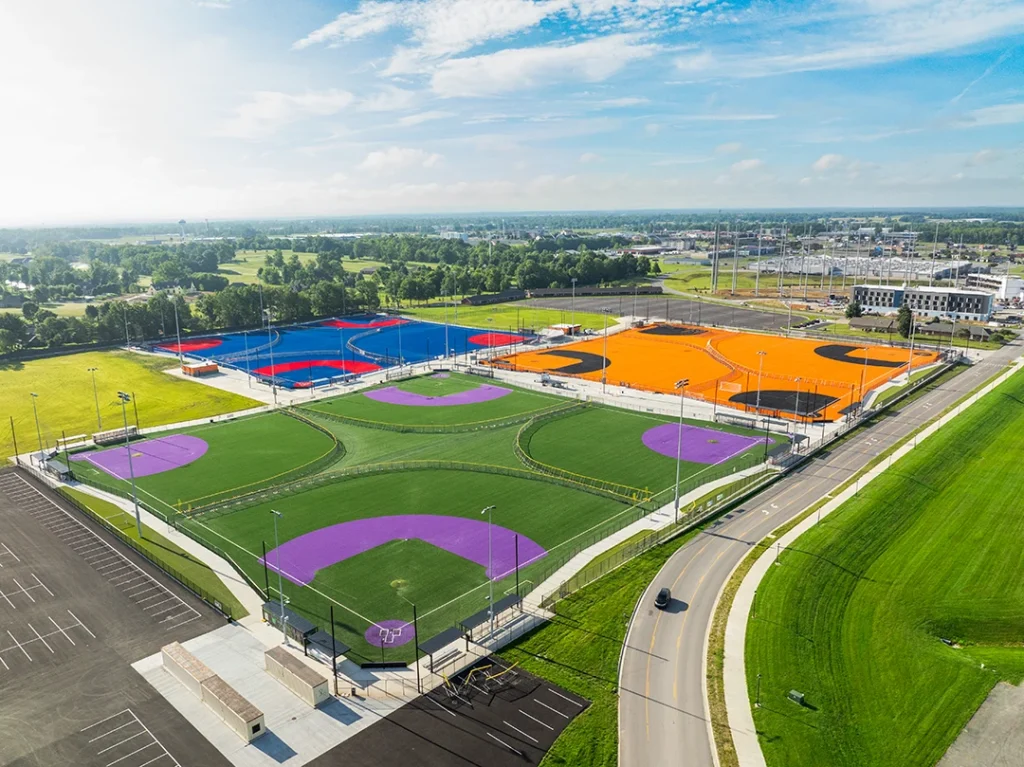
Spectator experience requires its own design consideration on a multi-sport field, since seating that works well for a diamond sport does not always work as well for a rectangle sport, and vice versa. One approach involves organizing multiple sports around a shared cluster of fields with multiple bleacher locations, allowing spectators to be positioned well for whichever sport is in play, whether that means several diamond fields grouped with adjacent rectangle fields in between them.
This kind of layout typically requires either movable bleachers or multiple fixed bleacher locations so that seating can be positioned appropriately depending on which sport is active. Dugouts, sidelines, and other permanent features also need to be spaced thoughtfully so that structures built for one sport do not interfere with sightlines or access for another.
What Should A School Consider Before Deciding On A Multi-Sport Field?
A few factors typically drive this decision. The number of distinct sports a school needs to accommodate is the starting point. From there, land availability and future land use plans matter significantly, particularly for schools weighing whether to consolidate multiple single-use fields into fewer, more efficient multi-sport surfaces.
Budget plays a role on both ends of the spectrum. Some schools have ample land but a limited construction budget, which makes maximizing the usage of a smaller turf footprint the priority. Others are working within tightly constrained urban sites and are looking for ways to consolidate several existing single-use fields into fewer, more flexible ones, sometimes freeing up land for other use in the process.
Long-term maintenance and replacement costs are also worth factoring in. A single multi-sport field typically costs somewhat more to maintain than one single-sport field, roughly one and a half times as much given its more frequent and varied use, but that is still meaningfully less than the cost of maintaining two or more separate single-purpose fields.
Does A Multi-Sport Field Cost More Than A Single Sport Field?
Yes, modestly. Designing for multiple sports typically increases construction cost by roughly five to ten percent compared to a single-sport field, driven mainly by the additional turf area required to accommodate expanded dimensions and the cost of inlaid markings for each additional sport.
That said, a multi-sport field is substantially less expensive than constructing two or more separate single-purpose fields to serve the same number of programs. For schools trying to serve multiple sports within a constrained budget, a well-designed multi-sport field is often the more efficient long-term investment.
What Is The Biggest Misconception Schools Have About Multi-Sport Fields?
The most common misconception is that a multi-sport field will inevitably look cluttered or confusing, essentially a mess of overlapping lines. In practice, a well-designed multi-sport field reads clearly from sport to sport when the right color hierarchy and marking strategy are applied. Spectators sitting behind home plate for a baseball game or at the fifty yard line for football should have a clear, uncluttered view of the sport they came to watch.
It is also worth setting realistic expectations. A multi-sport field does not eliminate the need for scheduling coordination between programs. What it does provide is significantly more usable field time from a single capital investment, rather than requiring separate investments, and separate long-term maintenance obligations, for each individual sport.
Do Schools Ever Regret Choosing A Multi-Sport Field?
Based on experience, schools that choose multi-sport field design generally do not regret that decision. If anything, the more common regret runs in the opposite direction: schools that build separate single-use fields sometimes find themselves locked into that configuration, since converting existing single-sport fields into a combined multi-sport layout after the fact is considerably more difficult than designing for multiple sports from the beginning.
Does Multi-Sport Design Change How Much A Field Get’s Used?
Significantly, and often for reasons beyond simple math. When a field is designed and treated as a shared, multi-sport resource rather than being associated with a single team or program, usage tends to increase substantially, sometimes three to four times the level of use a single-purpose field would see.
Part of this comes from a shift in mindset. A field that isn’t “owned” by one team or program becomes available to other groups that might not have had a similar opportunity otherwise, including youth leagues, cheer and gymnastics programs, band programs, and other school or community activities that benefit from access to a well-maintained surface.
What Role Does Flag Football Play In Multi Sport Field Planning?
Flag football is one of the fastest-growing additions to multi-sport field planning right now. It has already been sanctioned as an interscholastic sport in several states, and its inclusion in the 2028 Olympic Games is expected to accelerate adoption across the remaining states over the next several years.
Flag football is also one of the more flexible sports to incorporate into an existing multi-sport layout, since it can be designed to work within a football field, a soccer field, or even a baseball field’s footprint. Schools planning multi-sport fields today are increasingly factoring flag football into that planning from the start, rather than treating it as an afterthought once demand for the sport increases locally.
For a closer look at what it actually takes to prepare a field for flag football, including markings, spacing, and equipment considerations, see our guide on how to prep your field for flag football.
How Does MMTH’s Vertically Integrated Model Change Multi-Sport Field Design?
Getting a multi-sport field right means every decision, turf, markings, orientation, drainage, seating, has to work in concert rather than being solved one at a time. That is what MMTH’s integrated design and construction process is built to deliver. Because design, engineering, and construction all operate under one roof, decisions can be tested and refined immediately rather than passed back and forth between separate firms over days or weeks, which means the tradeoffs inherent in multi-sport design get resolved in real time instead of getting locked in too early or discovered too late.
When a design idea needs to be checked against construction feasibility and cost in real time, having that conversation happen in the same room, rather than across multiple vendors, allows for solutions that a more fragmented process would likely never surface at all. The result is uncompromised standards for every sport a field carries, not a watered-down version of each. Schools and cities that plan for this early see the payoff in real utilization, land, and cost efficiency, and they avoid the constraints that come with building single-purpose fields that are harder to reconfigure later. With sports like flag football continuing to grow, that flexibility only becomes more valuable over time.