

What's Under A Turf Field And Why It Matters
by Dustin Forgy, Vice President of Field Construction
What’s Under a Turf Field — And Why It Determines Everything Above It
Most people evaluating a new athletic field focus on what they can see. The turf fibers. The team colors in the end zones. The track surface around the perimeter.
What they rarely see is what actually determines whether that field performs well for fifty years or starts showing problems in five. It is not the turf. It is everything underneath it.
The foundation of an athletic field, the layers of earthwork, drainage, and base material beneath the surface, is where fields are won or lost. Getting it right requires engineering, experience, and the right equipment working in the right sequence. Skipping steps or cutting corners at this stage creates problems that no amount of surface maintenance can fix later.
What Are the Layers Under an Athletic Turf Field?
A synthetic turf field is a system, not a surface. From the ground up, a properly built field includes several distinct layers, each doing a specific job.
Subgrade (native soil)
This is the existing ground beneath the site. Before any construction begins, the subgrade has to be evaluated, stripped of organic material, shaped to precise grades, and compacted to the degree that it can support everything above it. The quality of the native soil varies dramatically from region to region, and understanding what you are working with is the first critical decision of any field project.
Athletic fields are designed to allow for a maximum vertical rise of approximately one inch, which is the same standard used for building slab foundations. This threshold is what prevents visible settlement or frost heave from affecting the playing surface over time. Geotechnical engineers evaluate the existing soil to verify it can meet that standard under real conditions. If it cannot, they develop a specific treatment approach to bring the soil into compliance before construction moves forward.
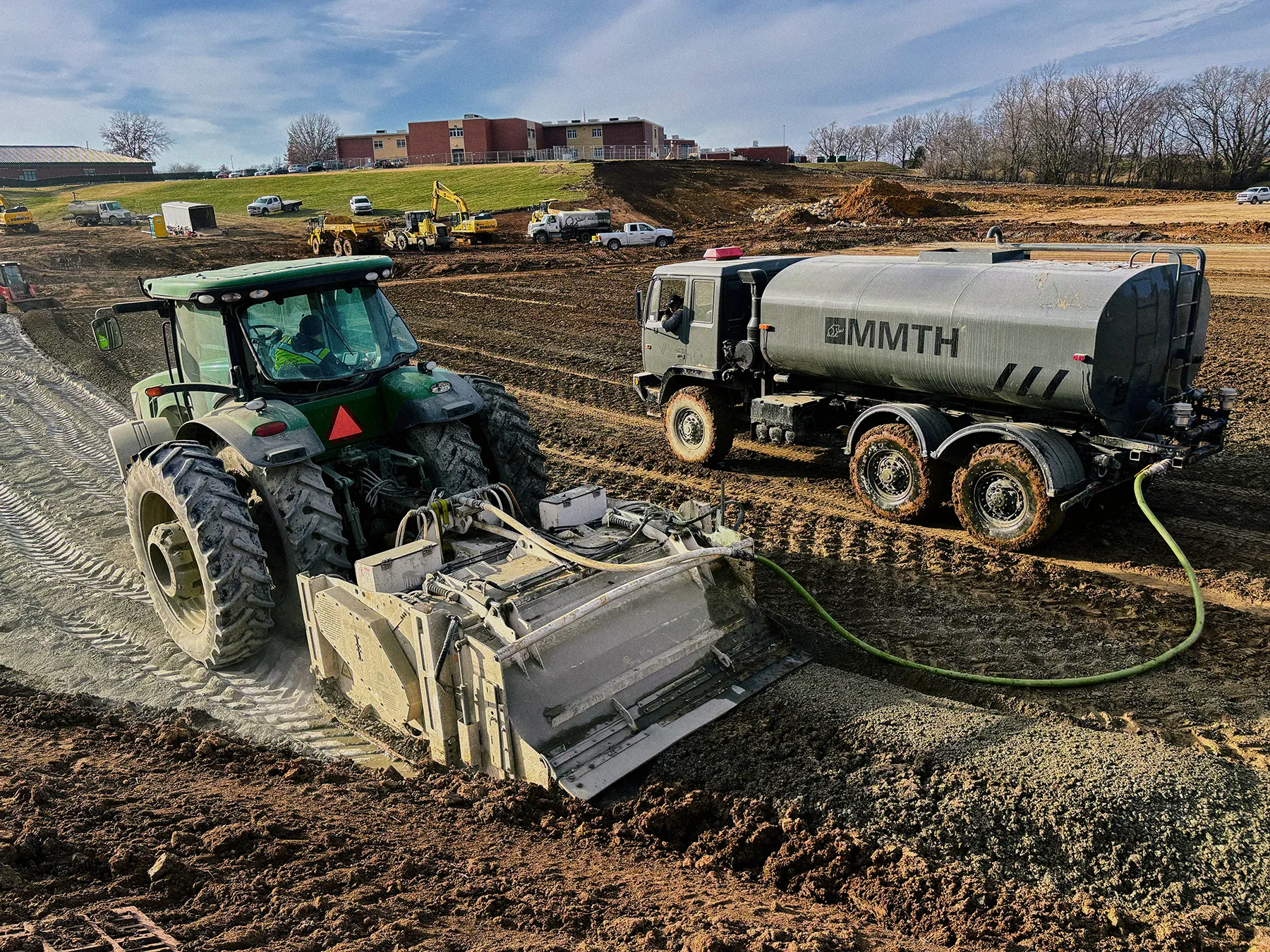
When the native soil is not stable enough on its own, it requires treatment before anything else goes on top of it. Depending on soil conditions, that treatment can take several forms: chemical stabilization using Portland cement or a similar binding agent to lock the soil in place, a thicker stone section above to bridge across weaker material, a specialty geotextile fabric that separates and reinforces layers, replacing the top layer of subgrade entirely with imported fill of higher quality, or some combination of these approaches. The right solution is determined by geotechnical testing, not by assumption. Skipping this evaluation and proceeding with a standard base profile on unstable soil is one of the most common causes of long-term field failure.
Drainage System
Once the subgrade is prepared, the drainage system goes in before any stone is placed. It consists of two components working together. The foundation of the system is a perforated perimeter drain pipe that runs around the outside of the field. This acts as the main collector, receiving water from across the entire field surface. The entire field is graded to slope toward these perimeter pipes so water has a consistent path to exit.
Running across the interior of the field in a herringbone pattern at 45-degree angles are flat drains that connect directly into the perimeter pipes. These flat drains intercept water and allow airflow throughout the field, continuously moving water off the surface and into the perimeter collection system. Together, the two components work as one: the herringbone flat drains gather water across the field and deliver it to the perimeter pipes, which carry it off the site by tying into a city drainage system, a surrounding swale, or another managed outlet.
Stone Drainage Base
Before any stone is placed, a geotextile fabric is laid across the entire prepared subgrade surface. This fabric separates the native soil from the stone above it, preventing migration of fine particles up into the drainage rock over time while still allowing water to pass through freely.
On top of that fabric goes a carefully engineered layer of crushed stone, typically six inches deep and made up of two distinct rock types. The lower portion uses a coarser aggregate that provides the primary drainage capacity and structural support. The top of that layer is capped with a smaller stone, typically one-quarter to three-eighths of an inch, which creates the precise, tight surface that the turf system sits on. The gradation of these aggregates matters for several reasons: it determines how freely water moves through the base, how stable the surface remains under heavy use, and how much water volume the base system is capable of holding before it needs to discharge.
Turf System
This is what you see and play on. The turf carpet, shock pad, and infill layers sit on top of the stone base. The performance of this system depends directly on the precision and stability of everything below it.
Why Does My Turf Field Hold Water After Rain?
A field that puddles after rain is almost always a base problem, not a surface problem. If the stone base is undersized, subgrade improperly graded, or the drainage pipes are not correctly sloped, water has nowhere to go. Over time, standing water undermines the base, softens the subgrade, and accelerates deterioration of the turf system above.
Well-designed fields are built to handle significant storm events, not just average rainfall. That means the drainage system is engineered with capacity to spare so that water clears the field quickly and consistently, not just on dry days.
Why Is My Turf Field Uneven or Settling?
When the subgrade is not properly stabilized or compacted, it continues to move over time. Freeze and thaw cycles, especially in northern climates, accelerate this process. The result is an uneven playing surface that creates tripping hazards, affects ball play, and ultimately requires expensive repairs or early replacement.
Proper compaction is not a single step. When building up the subgrade with fill material, compaction happens in eight-inch lifts. Each lift requires the right moisture content and verified compaction before the next lift goes on. Testing confirms that each layer meets the required threshold. Programs that skip this testing or rush through lifts often see no visible problem at first. Then five or ten years in, the base starts to move.
Stabilization is the other factor that is frequently underestimated, particularly in northern climates where deep frost levels put significant stress on the subgrade through repeated freeze and thaw cycles. When stabilization is not specified for the conditions or is skipped entirely to reduce upfront cost, the subgrade has no chemical lock holding it in place. What looks stable at installation begins to shift as moisture and temperature work on it season after season. It is one of the more common reasons a field that was installed correctly on the surface begins to fail from the ground up.
What Causes Turf Field Edges to Drop or Separate?
One of the most common issues on older fields is turf that drops or pulls away near the perimeter. There are two causes that tend to go hand in hand.
The first is grading. The base at the field edge needs to be back-sloped away from the curb so that water moves toward the perimeter drain rather than sitting against the concrete. When that slope is missing or incorrect, water pools along the curb, begins undermining it, and settlement follows.
The second is how the curb itself was backfilled. Improper backfilling behind and beneath the curb leaves voids or loose material that compact over time under load and weather. The right approach is to compact road base in lifts to bring the area up to the proper elevation before anything else goes on top. When either of these steps is skipped or done incorrectly, the result is the same: turf edges that drop, separate, and deteriorate well ahead of the rest of the field.
Does Soil Type Affect How a Turf Field Is Built?
It does, significantly. Soil conditions vary enough from region to region that what works in one area does not automatically work in another, and experienced field builders know the difference.
In much of the central United States, native clay soils are generally workable, but they still need to be tested for shrink-swell behavior — the degree to which soil expands when wet and contracts when dry. If a soil absorbs too much water and swells beyond acceptable limits, it will move the base above it. The acceptable threshold is typically no more than one-tenth of an inch of movement.
In the desert Southwest, soils can be dramatically different. In some areas, the native material is essentially powder. It requires heavy water application over time to become workable before grading can begin. In other areas of the same region, the native material is caliche, an extremely hard, concrete-like layer that cannot be graded with standard equipment and requires ripping to break up. Two fields in the same metropolitan area can present completely different construction challenges depending on where they sit.
In Florida, the soil profile is primarily sand, which changes drainage system design substantially. Water dissipates through the ground naturally rather than relying entirely on a pipe network, so drainage infrastructure can be significantly lighter than in clay-based regions.
Understanding these differences requires proper geotechnical investigation before any design decisions are made. It also means that the cost and complexity of base construction is determined by what the native soils on your site, not just by square footage.
How Is a Turf Field Graded to Drain Properly?
Turf fields are typically not flat. They are engineered to be close to flat, but with a specific and precise slope built in to move water off the playing surface and into the drainage system below.
The target slope on a synthetic turf football field is typically half a percent in any direction. That is six inches of elevation change over one hundred feet. It is almost imperceptible to the eye, but it is the difference between a field that drains in minutes and one that puddles for hours.
To achieve grades this precise across an 80,000 square-foot surface, modern field construction relies on GPS-guided and laser-controlled machine systems. Equipment equipped with these systems follows the digital design model exactly, achieving tolerances of less than an inch across the entire field. The final finishing pass uses a laser-guided box blade to achieve the precision required at the top of the stone layer before turf installation begins.
This level of precision is especially important on complex surfaces like baseball fields, where the outfield grade changes direction and cannot be set with a simple straight laser. A GPS controlled with laser assist machine eliminates the variation that used to require multiple manual passes and constant checking.
What Happens During Site Preparation Before a Field Is Built?
On many projects, the work that takes the most time is not the base construction. It is the earthwork that makes base construction possible.
Before any dirt moves, site preparation requires proper safety planning, signage, and erosion control measures. Silt fencing, inlet protection, and other erosion control practices are installed before earthwork begins to manage stormwater runoff and meet environmental requirements. This step is not optional and is often overlooked when people think about what site prep actually involves.
Once those controls are in place, earthwork can begin. The scope of this phase varies significantly depending on the project. On a standard single-field conversion, earthwork can be completed in as little as a week, with base building following over the course of a month. On a large multi-field complex built on raw land with significant elevation changes, the earthwork alone can involve moving close to one hundred thousand cubic yards of material and stretch considerably longer. The difference in crew size, equipment, schedule, and cost between those two scenarios is substantial, and it is driven almost entirely by existing site conditions.
Sites also present unforeseen conditions. A creek running through a site, rock close to the surface, or unexpected soil conditions discovered during excavation all require immediate decisions and adjustments. Having design, engineering, and construction expertise under one roof means those decisions can be made quickly without waiting on a separate firm to respond. When something unexpected appears at 7 in the morning, the people with the expertise to evaluate it and the authority to act on it need to be available immediately.
One consideration that is easy to overlook is what happens to the material that comes off a site during excavation. Hauling dirt off-site is expensive. Experienced earthwork teams plan for a balanced site wherever possible, incorporating surplus material into berms and site features that add character to the facility while eliminating the cost of importing or exporting fill.
Why Do Some Turf Fields Fail Early?
The most common field problems that appear years after installation are not surface problems. They are foundation problems. Poor subgrade stabilization, inadequate stone depth, improperly sloped drainage pipes, and rushed compaction are the root causes behind most premature field failures.
When fields are ripped out for replacement or repair, the base is often where the real story emerges. Undersized rock profiles, improper stabilization, and drainage details that were never properly executed show up clearly once the turf comes off. These are problems that were baked in during original construction and that no amount of surface maintenance was ever going to fix.
The question worth asking before any project is not just what turf system is going on the field. It is what is going under it, who is designing it, and how it will be verified.
Why Should the Team That Designs a Field Also Build It?
This is where the vertically integrated model of field construction makes a concrete difference.
When design, engineering, estimating, and construction exist in separate organizations, base construction decisions get made in isolation. An engineer designs a drainage system based on standards. An estimator prices it without field construction experience. A contractor installs it without the context of what the engineer intended. Problems get discovered late, and the cost of fixing them falls on the client.
When the team designing the drainage system is the same team grading the site and installing the pipes, every decision is informed by what is actually in the ground and what the project budget can support. Drainage details get refined during construction, not after. Soil conditions that change the base specification get addressed in real time. The field that gets built matches the field that was designed, because the people responsible for both are in the same conversation from the start.
Response time is another factor that rarely gets discussed until it becomes a problem. Field construction moves fast. Decisions that need to be made in the morning cannot wait two days for a design firm to respond. When the contractor has to pause work and sit on an unanswered question, that downtime has a real cost, both in schedule and in the crew time lost waiting for an answer. Most firms outside of the construction process do not fully grasp the pace at which field work happens, and that gap shows up as delays at the worst possible moments.
That integration also raises the standard for quality. When field crews know that their company’s name is on the surface going down on top of their work, the bar for base construction is different than it is for a subcontractor who moves to the next job the day the stone is placed.
What Should Schools Ask About Base Construction Before Approving a Field Project?
For school administrators and athletic directors evaluating proposals, the base system often goes unexamined. Proposals tend to focus on turf fiber, infill systems, and surface warranties. But the questions that most protect your investment are the ones about what happens underneath.
A few worth asking before any project moves forward:
- Do I need to have a geotechnical report done before installing or replacing a field?
- How is the drainage system designed, specifically how the perimeter collection pipes and interior flat drains work together. What storm event has it been engineered to handle?
- How will the field edges be handled, specifically the back-slope away from the curb and the compaction of road base during backfill, to prevent edge settling and separation over time?
- How will grades be verified across the top of stone before turf installation begins?
- What happens if unforeseen soil conditions are discovered during excavation?
These questions do not complicate a project. They protect it. The answers reveal whether you are working with a team that builds fields from the foundation up, or one that is focused on what you can see on opening day.
If your program is planning a new field or replacing an existing one, the most important conversation to have is about what goes under it. Connect with the MMTH team today to talk about your project.